

Winocour, S. et als.
Journal of Plastic, Reconstructive & Aesthetic Surgery, 2014-01-01, Volúmen 67, Número 1, Pages 34-41
 Pain in the early post-operative period following subpectoral placement of tissue expanders and implants is commonly reported. The current standard of care for pain control involves the use of oral narcotics. This study, determinated the efficacy of Botulinum toxin A (BTX-A) injections for pain relief following placement of subpectoral tissue expanders and breast implants.
 For more than 40 years, silver sulphadiazine 1% (SSD) is considered as standard therapy for the conservative treatment of burn wounds. However, in the last 10 years, substantial disadvantages of SSD have been reported in the literature and probably as a result of this, several new dressings for burn wounds have been developed and put on the market. The objective of this systematic review is to evaluate the available evidence on SSD in the conservative treatment of burns, specifically in comparison with the newer burn dressings that are increasingly being used nowadays.
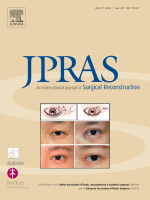 The majority of studies assessing the rupture rate of breast implants were performed by the breast implant manufacturing industry with questionable independence. After repetitive removals of ruptured implants from the same model, our team decided to assess the rupture rate and the estimated risk thereof for most of the silicone gel–filled implants we have used since they regained market approval in France in 2001.
 Después de la cirugía, las incisiones se suelen cerrar aproximando los bordes con suturas (puntos), grapas, adhesivos (pegamento) o broches. Este proceso ayuda a que los bordes incididos cicatricen juntos y se le llama «cicatrización por primera intención». Esta revisión pertenece a una serie de revisiones Cochrane que investigan las pruebas sobre antisépticos y antibióticos en diferentes tipos de heridas. También se propone presentar pruebas actuales relacionadas con la administración de antisépticos y antibióticos para las heridas quirúrgicas con cicatrización por segunda intención (SWHSI, por sus siglas en inglés).
 Autologous fat grafting (AFG) or lipofilling is nowadays a popular technique for breast reconstruction after breast cancer surgery. There is debate regarding the oncological safety and risks of this procedure in breast cancer patients. A systematic review of the literature published between January first 1995 and October first 2016 was conducted regarding the efficacy, safety and complications of this technique in breast cancer patients after their cancer treatment.
 Fingertip reconstruction using reverse-flow homodigital island flaps has been very popular over the years. However, the outcomes of reconstruction have not been clearly understood. In these circumstances, a systematic review of available literature is warranted. A PubMed [MEDLINE] electronic database was searched (1985 to 15 April 2015).








 Sitio web publicado el
Los lectores comentan