

Siotos, Ch. et als.
Plastic & Reconstructive Surgery: January 2019 – Volume 143 – Issue 1 – p 39–48
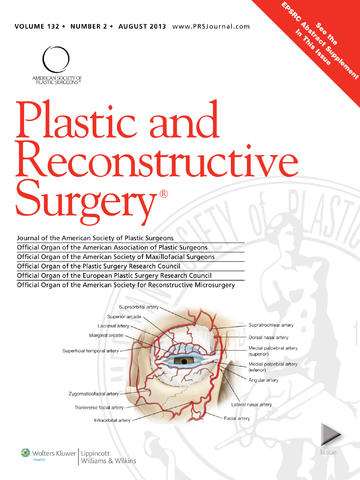 Postoperative skin necrosis in surgical patients is costly to hospitals and health care providers. Tumescent dissection technique is commonly used in mastectomy and immediate breast reconstruction, as it helps reduce blood loss; however, it may increase the risk of mastectomy skin flap necrosis. In this context, the authors have conducted a systematic review of the literature to perform a meta-analysis of the relationship between tumescent technique in mastectomy with or without breast reconstruction and complication rates.
 Flaps are increasingly popularized in reconstructive surgery and there is need to test and increase their reliability. Color Doppler ultrasound has been stated to be valuable in flap planning. The aim of this study was to conduct a systematic review and meta-analysis of the literature of Color Doppler ultrasound targeted pedicled perforator flaps and provide information on outcomes and complication rates.
 Burns of anterior shoulder joint surface and neighboring areas produce shoulder edge adduction contracture and scar deformity, slowing down the development of upper limbs in pediatric patients. Therefore, surgical reconstruction is indicated as early as the contracture is formed. Currently used surgical techniques, based on counter transposition of the local triangular flaps and skin transplants, do not solve the problem because of incomplete release of the contractures. Repeated operations are often performed. The scar deformity also remains.
 El colgajo sural de flujo reverso ha ganado gran popularidad, pero algunos autores describen como complicación frecuente la necrosis parcial o total del mismo. En este artículo, se presentan una serie de modificaciones técnicas propuestas por los autores para aumentar la viabilidad del colgajo cuando es necesario diseñarlo en su máxima extensión en cobertura de grandes defectos del pie.
 Over the years, the choice of recipient vessels for free flap autologous breast reconstruction has shifted from the thoracodorsal to the internal mammary vessels due to ease of flap inset and predictability of anatomy. However, thoracodorsal vessels are still great recipient vessels, and can be useful, especially in the previously failed or staged autologous breast reconstruction. In this study, we present our experience using thoracodorsal or serratus vessels for profunda artery perforator flaps.







 Sitio web publicado el
Los lectores comentan